Projects

A Mobile Computer Class for children and youth in Teshie

This innovative mobile solution ensures that even the most remote neighborhoods can access computers

Access to TECHNOLOGY is not a privilege — it’s a RIGHT!

About The Project

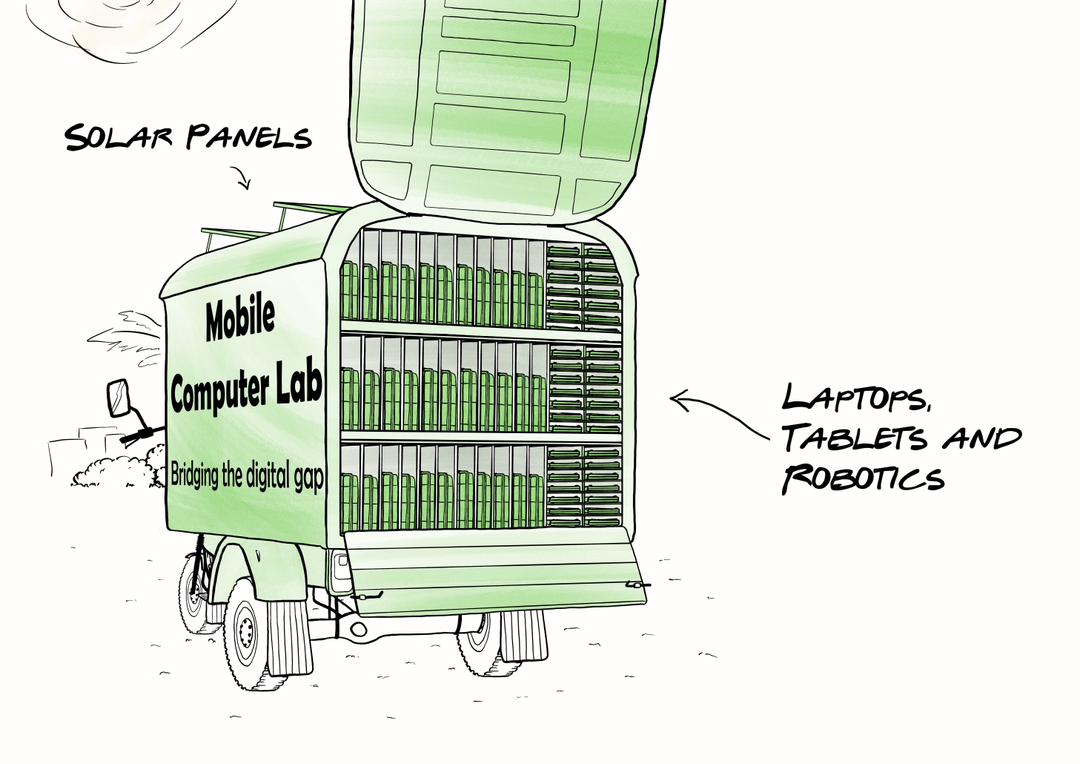
Imagine a classroom that drives right into your neighborhood — powered by solar energy, filled with laptops, tablets, and robotics kits, and open to every curious child eager to learn. That’s exactly what our Mobile Computer Lab does.


We are transforming a motorized tricycle into a fully functional mobile computer lab that delivers hands-on digital education directly to the children and youth of Teshie. This allows up to 50 students to learn interactively and hands-on — right within their school compound — following the Ghana Education Service (GES) ICT curriculum.


Many local schools teach IT theory without access to real computers. Our Mobile Computer Lab fills this gap by bringing technology directly to them, making digital education accessible, practical, and inspiring.


Our goal is simple yet powerful — to bridge the digital divide by providing access to computers, promoting digital literacy, and equipping young people with the practical skills they need to succeed in school and beyond. Through technology, we aim to empower an entire community with the knowledge, confidence, and creativity to shape a brighter, more connected future.

Why This Project Matters?

In Teshie, a coastal community in Accra and other communities in Ghana, many children are growing up without access to the technology that powers today’s world. For families who depend on small-scale fishing and low-income jobs, owning a computer or accessing the internet is often a distant dream. This lack of access limits the educational and career opportunities of thousands of young people, keeping them trapped in cycles of poverty and limited opportunity. Many children leave school early to help their parents on the fishing boats, while those who stay often face classrooms with no computers, no libraries, and sometimes even no textbooks. The Mobile Computer Lab changes this reality — bringing digital tools, internet access, and interactive learning right to the heart of the community. By turning technology into a vehicle for empowerment, we’re not just teaching computer skills — we’re opening doors to possibility, nurturing dreams, and preparing the next generation for a future powered by knowledge and innovation

What Do We Want to Achieve?

With this project, we aim to give at least 1000 children between the ages of 8 and 18, half of whom are girls, access to modern technology and the skills to use it. The goal is simple: to make these children digitally literate, so they can confidently face their future in the increasingly technology-driven world.
With a mobile computer classroom, we can empower the children with;
  • Digital skills: From basic computer skills to internet safety.
  • Increased opportunities: Prepare children for a technology-driven future.
  • Restored pride and hope: Show communities that progress is possible, even with limited resources.

How Does It Work?

Pilot Project Launch — January 2026

Our pilot project will officially launch in January 2026 in Teshie, in partnership with five local schools. Our Mobile Computer Lab will be equipped with 50 laptops, mobile internet connectivity, robotics kits, and educational software, providing up to 50 students the opportunity to engage in hands-on, practical learning aligned with the Ghana Education Service (GES) curriculum.

Targeting JSS 1–3 students, each mobile lab will reach up to 1,000 learners, with at least 50% girls, providing hands-on ICT, coding, and robotics training.
The pilot will run through July 2026, allowing us to evaluate outcomes, refine operations, and build a model ready for nationwide scale-up.

Project Timeline: 2026–2030

Phase 1: Pilot (Jan–Jul 2026)
Deploy Mobile Computer Lab in Teshie schools, train youth facilitators, and evaluate community impact.

Phases 2–5: Expansion (2026–2030)
Gradual rollout to other coastal and peri-urban communities across Greater Accra and beyond. Each phase will enhance digital access, training quality, and community engagement — ensuring long-term sustainability.

Vision
To build a society where digital inclusion is equitable, empowering, and transformative — enabling every individual to reach their full potential.

Mission
We believe that bridging the digital divide starts with access — access to technology, training, and opportunity.

By providing computers, robotics, 3D printers, AI tools, educational software, and reliable internet, we aim to empower children, youth, women, and persons with disabilities to become active participants in the digital economy.

Our programs foster creativity, innovation, employability, and lifelong learning, driving sustainable community development.

With your support, we can change this. Together, we can bridge the digital gap and create a future where every child has the tools to succeed.

Our Focus Areas

  • Practical ICT Training: Providing children with computer skills they can immediately apply.
  • Creative and Critical Thinking: Teaching how to use technology to solve problems and collaborate effectively.
  • Awareness: Promoting online safety, ethical behavior, and responsible internet use.
  • Support: Offering homework assistance and educational movie sessions on weekends to enhance learning.

Community Impact

The community impact of this mobile computer classroom initiative is multi-faceted, addressing critical needs and creating lasting benefits:

Provides underserved children and youth with access to technology, reducing the gap between those with and without digital resources.

Offers practical ICT skills, boosting academic performance and equipping children with tools relevant to the modern world.

Facilitates learning through engaging workshops and sessions that complement school curricula.

Encourages creative and critical thinking, enabling children to use technology to solve real-world problems and collaborate effectively.

Inspires children through educational movies and documentaries, broadening their horizons and ambitions.

Educates children about responsible internet use, online safety, and ethical behavior in the digital space, fostering a safer and more informed digital community.

Creates a shared learning environment where children and families can come together, fostering a sense of community and collective growth.

Complements local school efforts by bringing technology directly to classrooms, enhancing the learning experience without imposing logistical challenges.

Instills a love for learning and exploration, empowering children to pursue education and personal development well into adulthood.

This project will empower individuals with digital literacy and skills, foster innovation and creativity, and create a ripple effect of positive change across the community. It will prepare the next generation to thrive in an increasingly technology-driven world while uplifting the local community as a whole.

The mobile computer class SDG’s

The outlined goals align closely with several Sustainable Development Goals (SDGs), including Quality Education (SDG 4), Gender Equality (SDG 5), Decent Work and Economic Growth (SDG 8), Industry, Innovation, and Infrastructure (SDG 9), and Sustainable Cities and Communities (SDG 11).Here's how this project supports and achieves these goals: